
Cheliabinsk
The Urals • Gateway to Siberia
An industrial powerhouse on the eastern slope of the Ural Mountains, Cheliabinsk became a Jewish center in the early 1900s. For forty-five years, the entire region was sealed off from the world — a closed military zone hiding Soviet nuclear secrets.
The Moorish Revival Synagogue
Built in 1905, the Cheliabinsk synagogue rose in the Moorish Revival style — horseshoe arches and decorative brickwork that would have been at home in Budapest or Berlin. It announced that Jewish life had come to the industrial frontier.
The community never had long to enjoy it. In 1929, the Soviets seized the building and turned it into an industrial club. The neighborhood was walled off, declared a closed military zone for nuclear research. For decades, Cheliabinsk vanished from maps — a city that did not officially exist.
The building survived. In 2000, it was returned. Then, in 2013, a meteor exploded over the city — a ten-ton rock from space that shattered windows across Cheliabinsk, including the synagogue's stained glass. The community repaired them, gathering for Shabbat the same night.
Today, the synagogue stands at the center of a revived Jewish community — a Moorish jewel in an industrial city, still standing after revolution, secrecy, and falling stars.
Photographed by William Brumfield
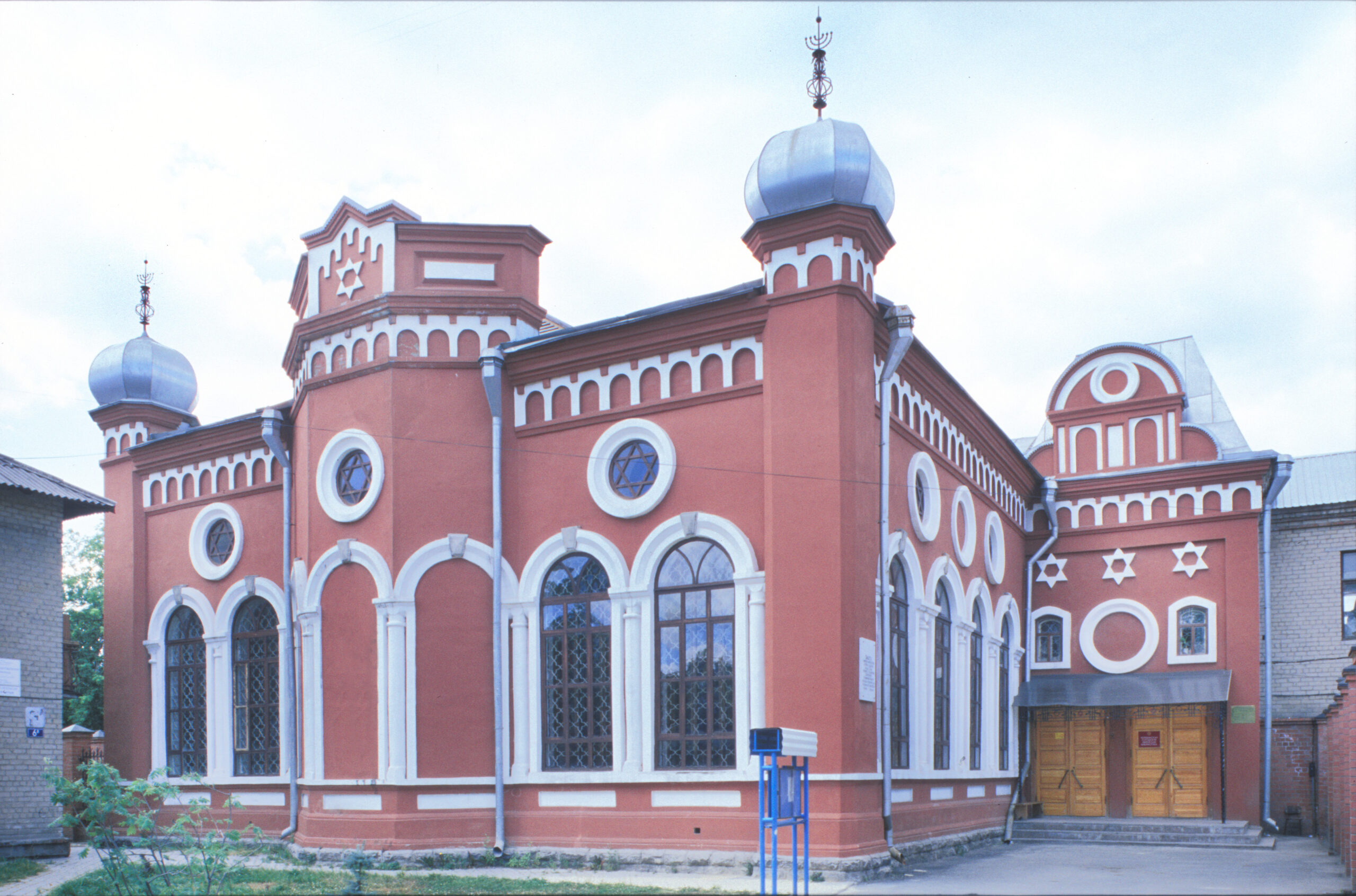
Synagogue Facade
This photograph by Professor William Brumfield captures the Cheliabinsk synagogue shortly after its return to the Jewish community in 2000. His documentation preserved this view of the Moorish Revival facade during the building's restoration.
Sources
Center for Jewish Art, Hebrew University of Jerusalem
Chabad.org — "Falling Meteor Causes Damage to Siberian Synagogue," February 15, 2013
International Jewish Cemetery Project — Chelyabinsk
Around Us — "Moorish Revival synagogue in Chelyabinsk"