
Tomsk
Siberia · Cradle of the Cantonist Community
Tomsk is one of the oldest cities in Siberia, founded in 1604 on the Tom River, and today it has the largest Jewish population of any city east of the Ural Mountains — roughly 4,000 people. The community here carries a story unlike any other in the archive.
The first Jews arrived in Tomsk as exiles and convicts from the Polish partitions, but the community took its enduring shape through the Cantonists: Jewish boys conscripted under Tsar Nicholas I’s 1827 decree, taken from their families as young as eight, and forced into 25-year terms in the Imperial Army. Many were stationed in Siberia. The ones who survived — and who held onto their Judaism through decades of pressure to convert — settled where they had served. Tomsk became a center of that return.
Two synagogues anchor the architectural record of that history. Both were confiscated by the Soviets, both stood derelict for most of the twentieth century, and both have been returned to the Jewish community within living memory.
Choral Synagogue, Rosa Luxemburg Street 38
FOUNDED 1902 · RETURNED 1999 · RESTORED 2010
The Choral Synagogue at 38 Rosa Luxemburg Street was founded in 1902, with many of its original congregants drawn from the city’s Cantonist population. Bolshevik authorities seized the building after the revolution and converted it to a courthouse, where it remained for the entire Soviet period. The Russian government returned the synagogue to the Jewish community in 1999 — the same year Professor Brumfield photographed the building during fieldwork in Tomsk. A long restoration followed; the synagogue reopened in 2010 under Chabad emissary Rabbi Levi Kaminetsky. Today roughly 300 congregants gather here for the High Holidays.
In September 2021, on the 120th anniversary of the synagogue’s founding, the community inaugurated a 25,000-square-foot Children’s Cultural and Educational Center on the adjacent lot — the largest Jewish educational facility in Siberia.
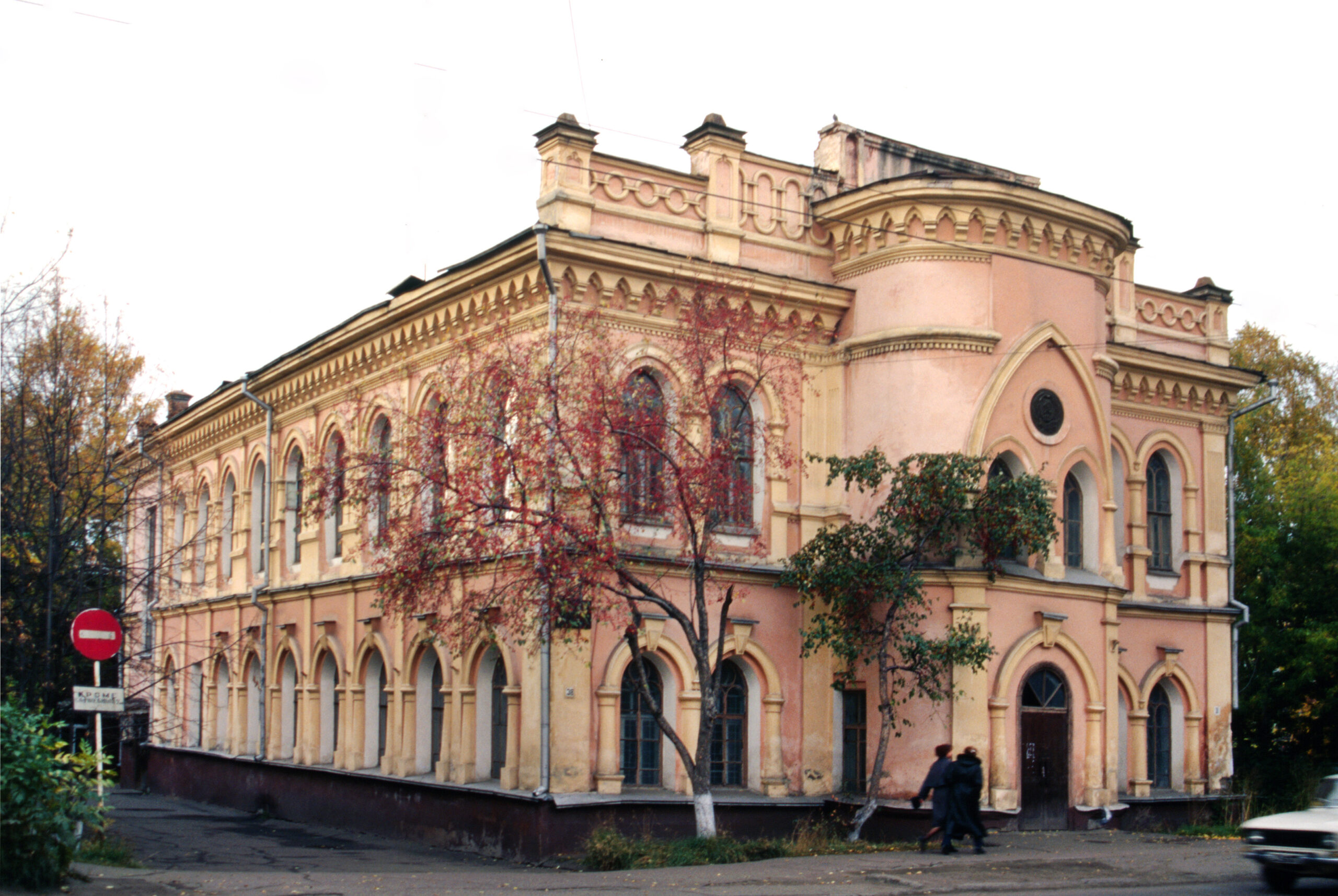
Choral Synagogue, Rosa Luxemburg Street 38, Tomsk
Photographed by William C. Brumfield
September 25, 1999
The Cantonists
JEWISH CHILD SOLDIERS AND THE SIBERIAN COMMUNITY THEY FOUNDED
The Cantonist Decree of 1827 obliged Jewish communities to supply ten boys per thousand residents to military boarding schools, where they were prepared for service in the Russian Imperial Army. Roughly 75,000 Jewish children were taken under this system between 1827 and 1856. Many were stationed in Siberia. A significant number resisted heavy pressure to convert to Christianity, and on discharge — granted residency rights in regions of the empire normally closed to Jews — they remained in the cities where they had served. Tomsk became one of the largest such Cantonist settlements, and the religious resilience of that community has made the city a symbol within Russian Jewry.