
Irkutsk
The Jewish community of the eastern Siberian capital, from cantonist soldiers and Kyakhta tea merchants to the oldest continuously operating synagogue east of the Urals.
A city at the edge of empire
Founded in 1661 as a Cossack outpost on the Angara River, Irkutsk grew in the eighteenth and nineteenth centuries into the administrative capital of Eastern Siberia and the commercial gateway between European Russia and Qing China. Its merchants grew wealthy on the overland tea trade through Kyakhta; its governors administered a territory larger than most European nations; and its prisons and exile depots received a steady stream of dissidents, criminals, and religious minorities dispatched east by imperial decree.
It was within this combination of frontier commerce and forced migration that a Jewish community took root in Irkutsk — a community shaped, unlike those in the Pale of Settlement, not by centuries of continuous residence but by the particular conditions of Siberian life: distance from central authority, relative religious tolerance among the region's many displaced peoples, and the need, in a thinly populated land, for anyone willing to trade, build, and stay.
Cantonists, exiles, and merchants
The first substantial wave of Jewish settlement in Irkutsk came not by choice but by conscription. Under the cantonist system introduced by Nicholas I in 1827, Jewish boys as young as twelve were taken from their families and enrolled in military battalions across the empire; many were sent to Siberian garrisons, where twenty-five-year terms of service meant that those who survived often remained in the East as discharged veterans. A second current of forced migration brought Jewish convicts and political exiles eastward along the Great Siberian Road. By the 1860s these two streams — soldiers and exiles — had produced a small but durable Jewish population in Irkutsk, supplemented by the wives, children, and relatives who followed them.
The same distance from Moscow that made Siberia a place of punishment also made it, for some, a place of unexpected freedom.
A third group proved decisive for the community's shape: merchants of the First and Second Guilds who, under a series of nineteenth-century exceptions to the Pale, were permitted to reside outside it for the sake of Siberian commerce. Families such as the Domblers, Feinbergs, Patushinskys, and Novomeiskys established trading houses in Irkutsk that dealt in tea, furs, gold, and, later, industrial goods shipped along the Trans-Siberian Railway. By the 1897 imperial census, Jews numbered over seven thousand in Irkutsk, more than seven percent of the city's population — a proportion unmatched anywhere else in Russian Asia.
Wealth did not erase restriction. Irkutsk's Jews lived within a web of imperial regulations that governed where they could build, what titles they could hold, and which guilds they could join. But within those limits, the community built: a hospital, a school, a cemetery, mutual-aid societies for the poor, a Talmud Torah for boys, and, at the symbolic center of its civic life, a great stone synagogue.
The Great Choral Synagogue
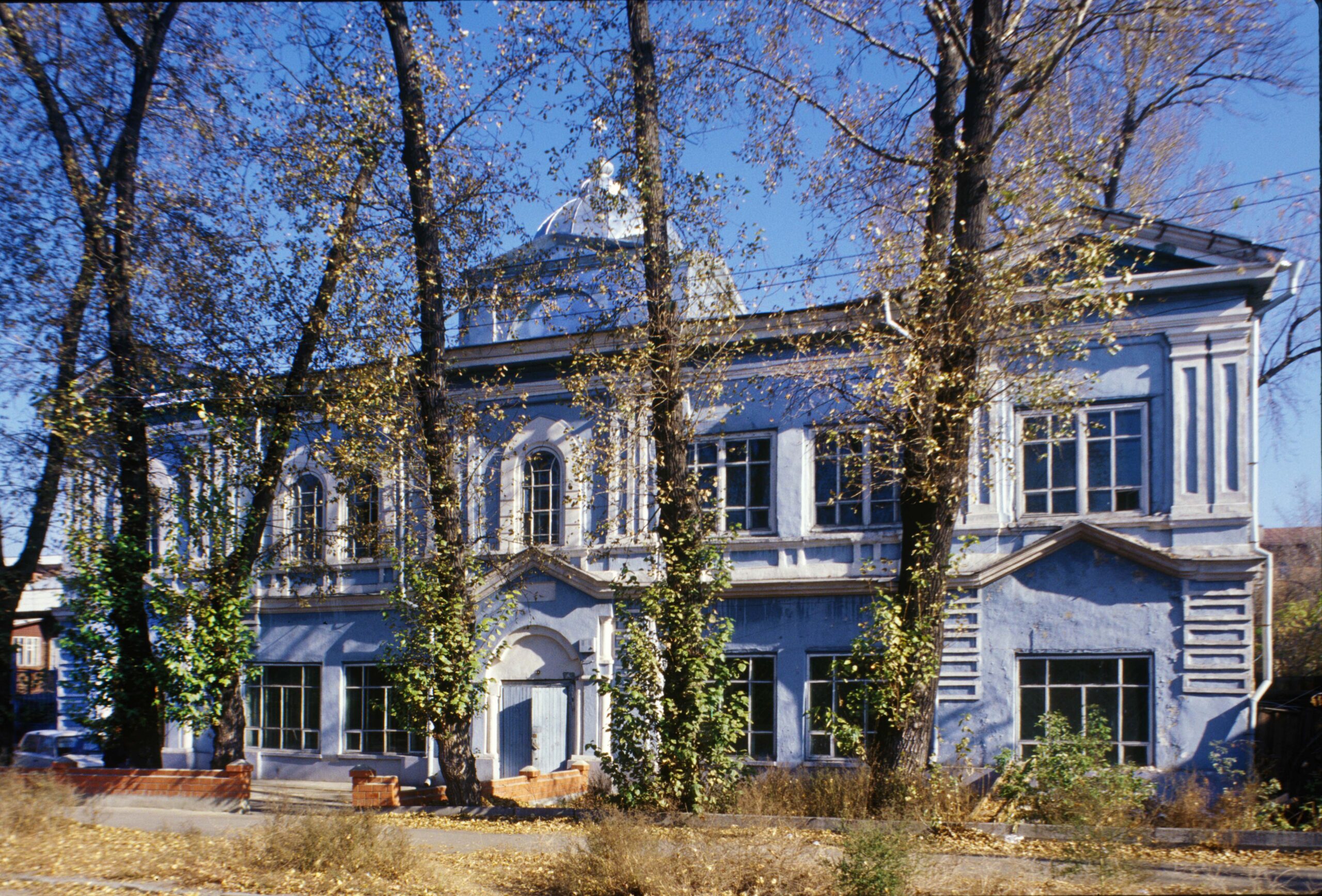
Completed in 1879, Irkutsk's Choral Synagogue stands today as the oldest continuously operating synagogue east of the Urals. Its construction was funded largely by subscription among the city's merchant families, and its scale — a two-story masonry building with a prominent arched facade and a galleried sanctuary — reflected the community's confidence in its permanence. The synagogue was not merely a house of prayer; it housed the rabbinical court, the communal archives, and the schools, and it served as the meeting ground where exiles, merchants, and laborers gathered as a single congregation despite the social distances between them.
The building has survived what the community around it has not always been able to: the pogroms of 1905, the revolutionary violence of 1917 through 1920, the Soviet closure of Jewish institutions in the 1930s, and a devastating fire in 2004 that gutted the upper floor. Each time it has been restored. The current sanctuary, rebuilt after the fire, continues to hold regular services and functions once again as the organizational center of Jewish life in Eastern Siberia.
Revolution, Soviet rule, and after
The Russian Civil War cut deeply into Irkutsk's Jewish population. Retreating White forces under Ataman Semyonov conducted violent reprisals across the region, and waves of typhus and famine accompanied the collapse of the imperial economy. Many prominent merchant families emigrated to Harbin, Tianjin, Palestine, or the United States during this period, taking with them the capital and institutional continuity that had sustained the prewar community.
Under Soviet rule the remaining community was formally deprived of its religious institutions. The Talmud Torah was closed; the Hebrew press was silenced; the synagogue itself was reduced to a single functioning hall, watched by the authorities and maintained by a shrinking congregation of older worshippers. Yet Jewish Irkutsk did not disappear. Soviet-era evacuations during the Second World War brought new Jewish residents east from Ukraine and Belarus, and the postwar decades saw a quiet persistence of family observance, Yiddish-speaking households, and informal community life behind the walls of apartment blocks.
Since the collapse of the Soviet Union, Irkutsk's Jewish community has undergone a modest but meaningful revival. The synagogue was returned to community ownership; a Jewish cultural center, religious school, and kosher kitchen have since opened; and annual observances of Holocaust Remembrance Day and the 1905 pogrom anniversary have been established at sites around the city. The community today numbers in the low thousands — a fraction of its prerevolutionary size, but an unbroken link to the soldiers, exiles, and merchants who built Jewish life at the edge of the empire.
What remains
The material heritage of Jewish Irkutsk is concentrated in three principal sites: the Great Choral Synagogue on Karl Liebknecht Street; the old Jewish section of the Jerusalem Cemetery, now a municipal memorial park, where a stone monument marks the reinterred remains of the nineteenth-century community; and a scatter of merchant houses in the city's historic center whose carved lintels and iron balconies still bear the names of the families who commissioned them.
Taken together, these sites form a quiet but legible map of a community that arrived under compulsion, built under constraint, and has proven — across two centuries of imperial, revolutionary, and Soviet upheaval — remarkably difficult to erase.